

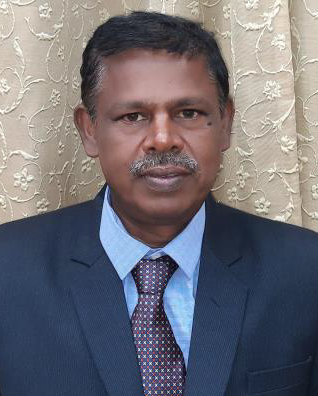
डॉ. एस. राजू
महानिदेशक
DR. S. RAJU
DIRECTOR GENERAL
भारत सरकार
खान मंत्रालय
भारतीय भूवैज्ञानिक सर्वेक्षण
GOVERNMENT OF INDIA
MINISTRY OF MINES
GEOLOGICAL SURVEY OF INDIA
Petrography is one of the pillars that hold up the castle that is known as Geology. A rock holds many secrets. Some of them are readily observable in the field or with the help of a pocket lens. But the intricate and complex interrelations between the minerals in a rock need studies under an optical microscope at the very least and more elaborate petrographic techniques including Scanning Electron Microscope, Back-scattered Electron Imagery, Cathode Luminescence Study, Laser Raman Images, or Transmission Electron Microscopy for deeper understanding. The texture of the rock is significant because the same exhibits size, shape, arrangement, and sorting of constituent minerals in a rock, and is thus a unique characteristic feature of the petro-physical attributes of rocks. Even a simple optical microscope can reveal secrets that go a long way toward an understanding of rock formation, deformation, and its evolution in response to changing pressure –temperature conditions or its responses to chemical changes during fluid flux.Petrography is the very fundamental step toward the understanding of terrain evolution, genesis, and estimation of the economic potential of rock.
To a geologist, a rock may be of varied interest. A volcanologist may like to know how crystallization progresses in cooling lava. To a sedimentary petrologist, the texture may speak out of the processes involved by a paleo river or may be of wind actions in a desert lost in time, other prominent geomorphologic processes. The structural geologist is interested in understanding the ductile or brittle behavior of minerals under stress while a miner focuses on the proportions of ore and gangue in his rock. The devoted fluid inclusion specialist spends hours revealing the secrets held within the trapped fluid in crystals and a gemologist turns on his gemoscope to peer into the fiery hearts of gemstones that hold the key to their natural origin, their beauty, and/or their flaws. For all of them, the very first tool is petrography.
Geological Survey of India (GSI) being the premier geoscientific organisation has a huge legacy database of more than 170 years. GSI places utmost importance on petrological studies both for mapping, R&D, and exploration projects.The Institution thus possesses a plethora of formal and informal personal collections of many of its geoscientists working for decades in this fundamental field, which is of great significance. Some of the collections might have insignificantly included or even escaped incorporation in the formal reports and publications. This particular endeavor to prepare an online Rock Texture Atlas of India by GSI emanated from the thoughts that the above formal and informal treasures of several geoscientists of this premiere organisation would be collected, collated, and compiledto generate a rich collection of available prominent rock textures observed in India, for dissemination of a great heritage of a classified knowledge on one of the very fundamental aspects of understanding the insights of various rock types in the country.
This Atlas has been prepared as a ready reference for all young geoscientists as they take up new projects, as well as also would be used as a rich material of basic reading for the students and researchers. The main focus of the Atlas will be petrography under an optical microscope. A young scientist from GSI, a research scholar beginning his or her endeavor, or anyone interested in the wonderful subject of geology will find a ready repository of textures under various fields of geology for a quick recapitulation. Each texture is associated with a proper caption and each chapter involves a short write-up on the subject as valuable refreshing content to the readers. This way, all will be able to access the accumulated experience of many in a single common, easy-to-accessible digital platform.
The Rock Texture Atlas of GSI was planned when the world came to a virtual standstill during the first pandemic lockdown in 2020. Our initial objective was to use the time to bring together the knowledge that is available in personal albums of the enthusiasts of the Earth Science domain within the Geological Survey of India. Our Project proved to be bigger than what we planned. We had active participants from all over GSI who sent photographs they deemed suitable for the various topics under petrography. In this endeavour, our retired geoscientists havealsocontributed immensely to fulfilling the relevant gaps. We also acknowledge some excellent contributions from selected academicians, who happily shared their data and experience ofGSI in this endeavour. The Atlas is thus a collective initiative of an entire Institution and more -of a whole community of devoted geoscientists for the benefit of future budding geoscientists. We hope that the online Atlas has brought out a sufficiently wide spectrum of rock textures and micro-structures for consultation by the students, and professional geoscientists working in different geological terrains in the country.
The online Rock Texture Atlas has been planned as an ongoing project. It will be uploaded phase-wise and will be added and updated in the coming months and years.The Atlas is divided into eleven chapters based on different aspects of petrography. There are scopes for future modification and addition on receiving betterquality photographs under any of the sub-topics. Apart from the chapters included in the context, in the future, new chapters may be added whenever suitable material is received from interested scientists.
We hope that this online treasurehas brought together a sufficiently wide spectrum of textures and microstructures for a benefit of further study and research in the fundamental fields of geoscience.
Dated: August 15, 2022, Kolkata
Dr. S. Raju
Director General
Geological Survey of India