

RockTextureAtlas
Search here
ForewordNote From CoordinatorAcknowledgementTextures in Igneous RocksTextures in Pyroclastic RocksTextures in Sedimentary RocksTextures in Metamorphic RocksDeformation related MicrostructuresVugs,Veins and PseudotachyliteTextures of Shock MetamorphismTextures in Chondritic meteoritesFluid Inclusion microstructuresGemstones
Textures in Pyroclastic Rocks
Pyroclastic rocks are volcanic rocks that have clastic texture. Pyroclastic fragments are produced by processes connected with volcanic eruptions. These are particles expelled through volcanic vents without reference to the causes of eruption or origin of the particles. Closely related to pyroclastics are the hydroclastic fragments - a variety of pyroclasts formed from steam explosions at magma-water interfaces, and also by rapid chilling and mechanical granulation of lava that comes in contact with water or water-saturated sediments.
Ejectas produced during pyroclastic explosions are divided into three main categories viz. juvenile, cognate and accidental. Juvenile pyroclasts are derived directly from the erupting magma and consist of dense particles of chilled melt or crystals that were in the magma prior to eruption (pyrogenic crystals). Cognate particles are fragmented co-magmatic volcanic rocks from previous eruptions of the same volcano. Accidental fragments are derived from the subvolcanic basement and therefore may be of any composition. Pyroclasts are named according to a large variety of criteria but the fundamental basis is grain size (Table 3.1) giving three main types - ash (< 2 mm), lapilli (2-64 mm) and bombs or blocks (> 64 mm) (Fisher, 1961a; Schmid, 1981). Table 3.1 shows the size classification and nomenclature of different pyroclasts and also includes the names of unconsolidated tephra and the corresponding consolidated phase.
Table 3.1: Granulometric classification of pyroclasts and of unimodal, well-sorted pyroclastic deposits (modified after Schmid, 1981)
| Clast size | Pyroclast | Pyroclastic deposit | |
|---|---|---|---|
| Mainly unconsolidated: tephra | Mainly consolidated: Pyroclastic rock | ||
| >64mm | Block, bomb | Agglomerate, bed of blocks or bomb, block tephra | Agglomerate, pyroclastic breccia |
| 64-2mm | Lapillus | Layer, bed of lapilli Or lapilli tephra | Lapillistone |
| <2-1/16mm | Coarse ash grain | Coarse ash | Coarse (ash) tuff |
| <1/16mm | Fine ash grain | Fine ash | Fine (ash) tuff |
Pyroclastic fragments often mix with other epiclastic materials during volcanism or after the cessation of volcanic activity to form mixed deposits. Once indurated such deposits give rise to mixed pyroclastic – epiclastic rocks. Mixing of pyroclastic and epiclastic materials in the post-volcanic period take place under subaerial and/or subaqueous conditions. The Table 3.2 lists the names of the different pyroclastic rocks, corresponding pyroclastic – epiclastic and purely epiclastic rocks with similar average size of the clast components.
Table 3.2: Terms for mixed pyroclastic-epiclastic rocks (after Schmid, 1981)
←------------------------------------------increase in proportion of pyroclasts----------------------------------------
| Pyroclastic | Tuffites(mixed pyroclastic – epiclastic) | Epiclastic(volcanic and/or non-volcanic) | Average clast size(mm) |
|---|---|---|---|
| Agglomerate, agglutinate, pyroclastic breccia Lapillistone | Tuffaceous conglomerate,tuffaceous breccia | conglomerate,breccia | 64 |
| (Ash) tuff: coarse fine | Tuffaceous sandstone Tuffaceous siltstone Tuffaceous mudstone, shale | Sandstone Siltstone Mudstone, shale | 2 1/16 1/256 |
| 100% | 75% | 25% | 0% by volume |
Pyroclasts and Pyroclastic Rocks
A pyroclastic rock is a mixture of rock fragments, pumice, and volcanic ash. Depending upon the relative proportions of the components, pyroclastic rocks can be broadly classified as ash tuff, lapilli tuff, lapillistone, tuff breccias and agglomerate (Fig. 3.1a). Tuffs are further subdivided into lithic tuff (predominance of lithic fragments), vitric tuff (predominance of glass fragments), and crystal tuff (predominance of crystal fragments). 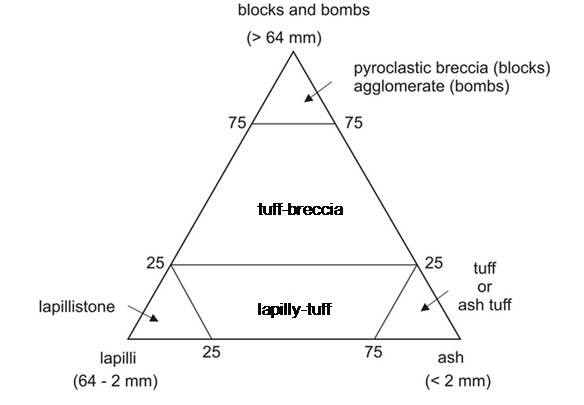 Fig. 3.1a. Mixture terms and end-member rock terms for pyroclastics (after Fisher, 1966)
Fig. 3.1a. Mixture terms and end-member rock terms for pyroclastics (after Fisher, 1966)Petrographic studies reveal that volcanic ash is a mixture of varying proportions of vitric, crystal and/or lithic particles of juvenile, cognate or accidental origin forming 75% or more by volume of an aggregate. Tuff is the consolidated equivalent of ash and it is further subdivided into coarse and fine varieties (Table 3.1; Fig. 3.1). Ash and tuff may also be qualified as vitric, crystal or lithic, according to the volume proportion of crystal, glass or rock fragments constituting the ash or tuff. Terminology for tuff and ash as per IUGS recommendations (Schmid, 1981; Le Maitre, 1989) is illustrated in the ternary diagram fig 3.1b with vitric, crystal, and lithic fragments as three end-members. 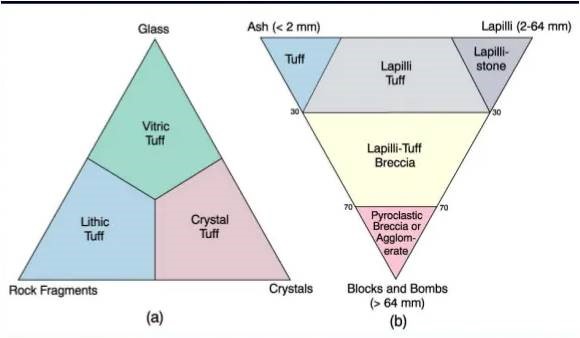 fig 3.1b. Terminology for tuff and ash as per IUGS recommendations
fig 3.1b. Terminology for tuff and ash as per IUGS recommendationsLapilli may consist of shards, pumice, fragments of volcanic glass, lithic fragments and broken or unbroken crystals. Lapilli may be juvenile, cognate or accidental. Lithified aggregates with >75 volume percent of lapilli may be classified as lapillistone (Table 3.1; fig. 3.1a). Lapilli are commonly angular to subrounded in shape and the latter forms are mostly of juvenile origin. Accretionary lapilli are lapilli sized particles consisting of an aggregate of ash-sized particles. These spheroidal bodies are made up of concentric layers of fine ash materials accreted during flight of a pyroclast in a moist condition in the eruption cloud. Armoured lapilli (Waters and Fisher, 1970, 1971) form when wet ash becomes plastered around a solid nucleus such as crystal, pumice or lithic fragments during hydroclastic eruptions. 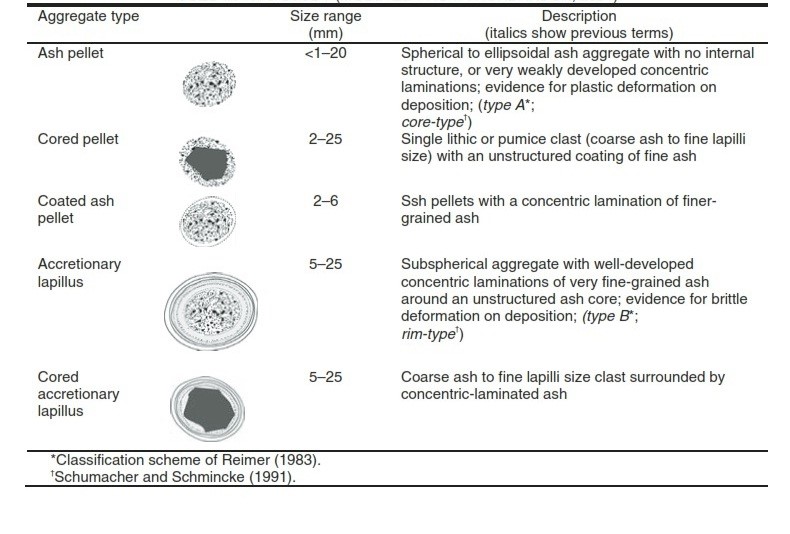
Blocks are commonly angular to subangular fragments of cognate or accidental origin. Blocks of juvenile origin may also develop from disruption of contemporaneously developed domes, or by the fragmentation of congealed bomb upon impact. Pyroclastic breccia is a consolidated aggregate of blocks containing less than 25 volume percent of lapilli and ash.
Bombs are ejected through vents in a partially molten state and solidify during flight or shortly after landing on ground. Agglomerate is a welded aggregate consisting predominantly of bombs and containing less than 25 volume percent of lapilli and ash particles.
Pumice, Shards, and Pyrogenic crystals
Pumice and scoria pyroclasts are formed by explosive disruption of vesiculating magma. Pumice is highly vesicular volcanic glass (with or without crystals), generally of silicic composition. The term scoria is usually used for similar pyroclasts of mafic to intermediate composition and this term is essentially synonymous with cinder. It may be noted that pumice and scoria fall in the size grade of lapilli and bombs. Pumice floats on water while scoria readily sinks in water. Scoria glass is brown to dark brown in colour. However, scoria of andesitic composition may also be colourless. Pumice is characterized by parallel to sub-parallel arrangement of extremely elongate vesicles which are either cylindrical or flattened with circular or rectangular outlines in transverse sections. Pumice showing tubular vesicles with curvilinear shapes has been noted. Tube pumice forms when vesicles are stretched during flow of vesiculating magma. Scoria of andesitic composition can be characterized by equant to elongate to irregular or contorted vesicles. The scoria of basaltic composition is characterized by spherical to sub-spherical vesicles. Basaltic scoria may also show polygonal lattice- like network of glass rods.
The phenocryst content of pumice and scoria ranges from zero to very abundant (more than 40 volume percent). Phenocrysts in pumice and scoria have the same textural characteristics as phenocrysts in non-vesicular or sparsely vesicular lavas
Shards are minute (generally <2 mm) particles of volcanic glass generated by explosive fragmentation of magma or lava ejecting through the vent. These glass shards are broken bubble walls or common junction walls of two adjacent bubbles of the vesiculated magma. It may be noted that there are a number non-vesiculation processes that produce shards but, in this write-up, apart from hydroclastites, only the shards produced by vesiculation processes have been discussed. Glass shards commonly dominate the ash grain size class of primary and resedimented pyroclastic deposits and can also be abundant in volcanogenic mudstone and sandstone.
The most common and familiar kinds of shards are silicic varieties formed from shattered bubbles. The three main types of shards that are formed from explosive eruptions of vesiculated silicic magma include :
- Cuspate shards or Y-shaped shards that are remnants of three adjacent bubbles. The type-1 shards also include double concave plates that formed the wall between two adjacent bubbles;
- Platy shards or flat or curviplanar fragments of the walls separating adjacent large vesicles and
- Pumice shards — these represent tiny fragments derived from shattering of larger pumice and these are also referred to as microvesicular glass ('micro-pumice', Heiken, 1972; 1974; Fisher and Schmincke, 1984; Heiken and Wohletz, 1991).
All three commonly occur together in deposits from a single explosive magmatic eruption. It may be noted that the type-2 shards may be sub-equant, rectangular, triangular, crescentic or even dagger shaped in their outlines with sharp edges and angular corners.
Shards from eruptions of basaltic magma are represented by sideromelane glass. Basaltic magma is much less viscous compared to high viscosity silicic magma and the explosivity of volcano erupting such low viscosity basaltic magma is less. Shard morphologies are manifested by irregular droplets with fluidal shapes such as spheres, ovoids, dumbbells, and teardrops. If the lava is particularly fluid, the bursting bubbles may hurl out the lava as fine sprays that cools readily while still suspended in air to form glassy pellets of teardrop shapes and such shard particles are known as Pele’s Tears. While still in fluidal state teardrop shard may get extremely stretched to form long delicate threads, known as Pele’s hair, if there is strong wind during spraying of lava.
Shards in deposits from phreatomagmatic or hydroclastic eruptions (volcanic eruptions resulting from interaction between magma and water) have diverse shapes, and a significant proportion are more blocky to equant and less vesicular than those from dry explosive magmatic eruptions. Shapes of the shards of hydroclastic origin are very similar irrespective of composition of the erupting lava.
Pyrogenic crystals of minerals are more abundant in pyroclasts of basic compositions as compared to the crystal content of pyroclasts of acidic lava. These are early formed crystal phases of the magma and are present as phenocrysts and/or microlites enclosed within the vitric and lithic particles which act as hosts to the crystals. Space available for free growth in the liquid magma aids the early formed crystals to attain near perfect euhedral shapes and such shapes are retained on sudden eruption and quenching of the magma. Crystals made free of enclosing vitric or lithic hosts during their flight after ejection owing to high explosivity of relatively more acidic volcanism are common and are regarded as crystal clasts. Crystal clasts may represent complete or broken parts of crystals. Content of crystal clasts may be significant in many pyroclastic air-fall tuff and tuffs of pyroclastic flow origin. It is difficult to estimate the crystal content of the erupting magma from the pyroclastic deposits as volume of crystal clasts are modified by sorting during eruption and dispersal. The crystals of quartz and feldspars often show embayments.
Pyrogenic crystals as described above are mostly represented by high temperature phases of the concerned minerals. The more siliceous varieties of pyroclastic deposits contain crystal clasts of bipyramidal quartz, tridymite, biotite having pseudohexagonal symmetry, high temperature disordered forms of plagioclase, and sanidine while crystal clasts of augite, hypersthene and hornblende are present in more mafic deposits. Minor accessory minerals, such as magnetite, ilmenite, fayalite, zircon, and apatite may also be present but are very sparse.
Quaternary Tephra beds of India – A distal facies of 75000 years old silicic volcanic eruptions of Toba volcano, Sumatra P. K. Mukhopadhyay
Unconsolidated volcanic ash (tephra) bed restricted to a single stratigraphic horizon is reported from the Quaternary sequence of many major and minor river basins of south, central, east and western parts of the Peninsular India. This tephra bed is reported from Sagileru (tributary of Pennar River) and Vamsadhara valleys in the south, Barakar River basin in the east, Son, Narmada, Purna, and Wardha river basins in the central India, and from Kukdi River section in the west.
The fine grained, white coloured, unconsolidated ash bed has low specific gravity and the colour turns to very light on exposure to air. The tephra is contaminated with clay and volume percentages of such contaminations vary from less than 2 to rarely about 30%. Apart from clay minerals insignificant proportion of minute grains of quatrtz, feldspar, biotite, and opaques are present as impurities.
The volcanic component of the tephra is represented by colourless and transparent, unaltered, coarse and fine ash sized highly angular glass shards in the size range of 10 to 435 µm with the majority of the shards being in the 60 to 100 µm in diameter. The shards include both bubble wall and pumice shards, the former being dominant over pumice.
The bubble wall shards are represented by both platy and cuspate shards. Platy shards are broken walls of large flattened bubbles and are rectangular, triangular, crescentic, and dagger shaped but may also be irregular in outline. Some of the platy shards are bowl shaped and some others show traces of parallel and straight walls of pipe vesicles on an otherwise flat surface. Cuspate shards show characteristic relief in contrast to the platy variety and represent junction wall of two more adjacent bubbles. Many such shards also retain parts of bubble walls.
Pumice fragments are fibrous in character and show parallel or subparallel alignment of pipe vesicles. The pipe vesicles are commonly elongate and straight but some of the pipe vesicles are curvilinear or contorted. Most of these vesicles are flattened in cross sections with length to width ratio always greater than 20 in longitudinal sections.
The refractive indices (R.I.) of the shards fall within a narrow range of 1.498 to 1.510. The colourless transparent nature of the shards and RI values indicate SiO2 content of more than 70%.
Tephra sample of Son has SiO2 content of 76.47% (Basu et al, 1987) and that of Kukdi basin has (Korisettar et al, 1989) 75.07% SiO2. The Narmada samples contain relatively higher percentage of impurities and the sample with least contamination has SiO2 content of 67.41%.
Grain morphologies and RI of the glass shards indicate derivation of the tephra as product of highly explosive silicic volcanism and relative abundance of platy and cuspate shards over pumice suggest derivation of the tephra from low viscosity silicic magma having temperature of more than 850oC (Izett, 1981). Fibrous nature of the pumice shards with length to width ratio always exceeding 20indicate low vapour pressure eruptive condition (Ewart, 1963).
It is postulated that the tephra of Upper Pleistocene age, preserved as discontinuous lensoid bodies within the river valley sediments, represent rapidly settled ash falls from a volcanic ash cloud that formed a canopy over large part of Peninsular India. This tephra bed is correlatable with the approximately 75000 years old silicic volcanic eruptions of Toba volcano, Sumatra.
(The work was carried out jointly by P. K. Mukhopadhyay and H. M. Ramachandra)
Ignimbrite
Ignimbrite is a deposit laid down by a hot pumiceous pyroclastic flow. Ignimbrites are unsorted mixtures of pumice lapilli and vitric ash. Most of these deposits are products of rhyolitic and dacitic volcanism but some are also andesitic. Lapilli are usually abundant and some of these particles reach size of bombs. Crystal clast content is variable – these are sparse in some ignimbrites while abundant in others.
The thick pile of ignimbrites is still hot when they are emplaced so that the pumice and ash fragments are still plastic and malleable. A rapidly accumulating pile of hot plastic glass fragments may deform plastically under its own weight or in response to gravity down the slope. Such collapse and fusing of vitric fragments form a welded tuff and strong directional alignment of the pumice and glass shards gives rise to eutaxitic texture. Shards at the upper and lower margins of rigid particles (crystals and lithic clasts) are typically the most strongly deformed and may be stretched, contorted or folded. The pumice fragments are compacted and flattened into dark, glassy discoid lenses; in longitudinal as well as transverse views these appear as thin lenticular streaks of dense dark glass, called fiamme. However, it has to be remembered that many ignimbrites are not welded or may show incipient welding and superficially resemble air-fall deposits. Therefore, welded tuff along with development of eutaxitic texture and fiamme structure are not exclusively characteristic of ignimbrites as these features are also noted in non-ignimbritic welded tuff.
Alteration of Glass
Volcanic glass is a super-cooled silicate liquid with a poorly ordered internal structure. SiO4 tetrahedra are loosely linked by other cations and there is considerable intermolecular space available in between. Having an unstable structure volcanic glass alters more readily than nearly all the associated mineral phases. Alteration or decomposition of volcanic glass during diagenetic conditions includes physical, mineralogical and chemical changes. The alteration is greatly influenced by water and therefore, glass shards in sub-aqueous or sub-marine conditions decomposes faster compared to the shards of sub-aerial pyroclastic deposits. Water in the pore spaces of the glass structure and the circulating groundwater play very important role in the breakdown and devitrification of volcanic glass. Equally important is the composition of the glass and role of the chemistry of the underground, surface or marine water. Workers have also established that within the realm of diagenesis, the alteration mineralogy in a thick pile of volcaniclastics changes with depth i.e., with increasing pressure and temperature. Silicic glass alters to opal, phyllosilicates, zeolites, quartz, and K-feldspar. Basaltic glass alters by reaction with water to palagonite – a brown or golden coloured product resembling a resinous substance. With increasing age and depth of burial palagonite is transformed to smectite which in turn gives rise to chlorite.
Volcanic glass is completely or partially decomposed beyond Miocene age and generally in deposits of still older ages glass is totally replaced by low temperature minerals. In the older pyroclastic rocks, the glass shards are replaced by aggregate of minerals. However, the shard shapes and pumice or scoria structures are identifiable under the microscope provided the deposit was not affected by deformation and metamorphism beyond green schist facies. Pyroclastic rocks in the volcano-sedimentary sequence of Proterozoic and Archaean terrains of low-grade metamorphism and affected by folding deformation may retain the typical shapes shard pseudomorphs in the strain partitioned zones. However, all the evidences of pyroclastic deposits are completely obliterated once the deposits are affected by higher grade of metamorphism and more intense deformation.
Pyroclastic Rocks: Notable Indian Occurrences P. K. Mukhopadhyay
Occurrences of pyroclastic rocks ranging in age from Late Archaean to Quaternary period are recorded across the Peninsular India in different geological set-ups. However, the most recent deposits of pyroclastics have been contributed by the Barren Island volcano in the Andaman Sea which is far away from the mainland of India. Both Barraen Island volcano and the pyroclastic beds within the Tertiary sediments of the Andaman Islands are emplaced or deposited in a much different geological set-up in comparison to the occurrences of the pyroclastic rocks in the Peninsular India. The occurrences of pyroclastics are presented in a chronological order beginning with the oldest.
Many Schist Belts, including Granite Greenstone Belts, show presence of pyroclastics. The Late Archaean Granite Greenstone Belts and Schist Belts of the Western Dharwar craton extending up to Goa coast in the west show presence of both acid and mafic pyroclastics. Similarly, acid and basic pyroclastics are recorded from a number of Late Archaean Schist Belts of the Eastern Dharwar craton as well. Early Proterozoic Granite Greenstone Belt of Sonakhan area situated in the northeastern Bastar craton hosts thick pile of pyroclastics of both acid and basic volcanic parentage. The rift related Early Proterozoic intra-cratonic linear Kotri-Dongargarh belt in the south-central and northern parts of the Bastar craton exposes both acid and basic pyroclastic litho-packages. Bimodal pyroclastics have been recorded from the Sakoli Fold Belt in the northwestern peripheral part of the craton and acid pyroclastics are also reported from the Chilpighat Group of meta-sedimentaries, mainly exposed in areas to the north of the Chattisgarh Basin of the northern Bastar craton. Sakoli Fold Belt rocks and the Chilpi sediments are regarded to be of Early Proterozoic age (̴1800 ma).These Late Archaean to Early Proterozoic occurrences of pyroclastics of the Dharwar and Bastar cratons have mostly been affected by moderate folding deformation and low-grade metamorphism as a result of which some of the features specific to pyroclastics are still retained though many field features and the clast morphologies have been modified to variable degree or totally obliterated.
Pyroclastic beds have been recorded from some of the Meso-Proterozoic Purana Basins of India exposing near horizontally disposed unmetamorphosed and undeformed pile of platformal sediments. These include Vindhyan Basin of the Bundelkhand craton exposing a very thick pile of clastic and chemical sediments with siliceous tuff beds reported from the basal part of the sedimentary sequence. Similarly, siliceous tuff beds are reported from the basal part of the Chhattisgarh Basin sitting on the northern and northeastern parts of the Bastar craton. The Cuddapah Basin situated on eastern peripheral parts of the Eastern Dharwar craton exposes a very thick pile of sediments having an estimated thickness of 6 to 12 km. Felsic tuffs are intercalated with the shale-dolomite dominated sequence at several stratigraphic horizons in the sedimentary sequence of this basin. In addition to the above, tuffs and tuffaceous rocks are also reported from many other Palaeo- and Meso-Proterozoic Purana Basins of smaller dimensions in southern and central India. The pyroclastics of the Purana basins being unmetamorphosed and undeformed many of the primary field characters and grain morphologies, including euhedral nature of the crystal clasts, are still largely retained. However, vitric fragments though completely pseudomorphed retain the shapes.
Pyroclastics, both acid and basic, are also reported from the weakly metamorphosed phyllite - chert dominated meta-sediments of the Early Proterozoic North Singhbhum Mobile Belt exposed on either side of the East – West trending Dalma volcanic belt.
Another notable occurrence of pyroclastics is associated with the Neoproterozoic Malani Igneous Suite (MIS) of the Aravalli craton. MIS is the largest felsic volcanic province of India represented by bimodal volcanics, granitoids and dyke swarms. The pyroclastics consisting of welded tuffs, vitric and lithic tuffs, ignimbrite, agglomerate, and volcanic breccia etc. are a part of the bimodal volcanics. The geochronologic age of the spatially associated volcanic rocks is about 745+5 ma. These pyroclastics are undeformed and unmetamorphosed and many primary features of the deposits are still retained though vitric clasts are completely altered.
The Deccan Trap lava of Uppermost Cretaceous age with a cumulative lava pile thickness of more than 2000 m extends over an area of more than 5,00,000 sq km mainly in the states of Maharashtra, Gujarat, and Madhya Pradesh shows presence of tuff beds at certain localities. Areas in and around Mumbai show exposures of pyroclastics of both acidic and basic compositions. These are discontinuous lenticular deposits having very limited extensions. Pyroclastics are also associated with acidic variants of Deccan Trap at several locations in Saurashtra area. Felsic tuffs are recorded from Sihor near Bhavnagar, from Pavagarh Hill, near Vadodara, and in areas near Longidi.
Next in order of lesser antiquity are the felsic tuff beds of the Andaman Islands. The tuff beds of Mio-Pliocene age are spatially associated with the clastic carbonate beds and are exposed in the South and Middle Andaman Islands and on the nearby smaller islands. The tuffs and the carbonates together represent the Archipelago Group of sediments. The rocks are unmetamorphosed and undeformed and the glass shards are affected only by diagenetic alteration. The glass is thoroughly replaced by zeolite group of minerals but the shard pseudomorphs retain the typical shapes strongly suggesting their pyroclastic origin.
The Quaternary tephra occurrences restricted to a single stratigraphic horizon in the alluvial complexes of a number large and small of river basins have already been discussed elsewhere in this write-up. However, the status of youngest pyroclastics of India goes to the tephra of the Barren Island volcano. Barren Island in the east Andaman Sea forming a part of the inner arc of the Burma-Andaman-Java subduction complex is the only active volcano in south Asia and located about 2000 km away from the mainland of India. In recent times this volcano has ejected relatively small volume of lava and pyroclastic material of basaltic composition on several occasions since the year 1991.It may be noted that the Barren volcano was active on a number of occasions prior to 1991. The earliest recorded eruption was in 1789 and there were several eruptions between 1789 and 1804 and again it became active in 1852. The eruption of 1991 was after a gap of about 140 years during which period the volcano remained dormant. It being a recent and present-day volcano the pyroclastics are unmodified, the scoria and shard morphologies are intact, and the vitric components are absolutely unaltered. Tephra is represented by ash size particles to blocks.
Interested readers may refer to:
- 'Pyroclastic Rocks' by Richard V. Fisher and Hans Ulrich Schmincke
- 'Volcanic Textures' by J. McPhie, M. Doyle and R. Allen for detailed discussions on pyroclastic rocks and their textures.
- 'Volcanic Successions: Modern and Ancient' by R. A. F. Cas and J. V. Wright
- 'Volcanic Textures' by J. McPhie, M. Doyle and R. Allen for detailed discussions on pyroclastic rocks and their textures.The chapter on pyroclastic rocks in ‘Petrography: An Introduction to the Study of Rocks in Thin Sections’ is very helpful in study of these rocks.