

RockTextureAtlas
Search here
ForewordNote From CoordinatorAcknowledgementTextures in Igneous RocksTextures in Pyroclastic RocksTextures in Sedimentary RocksTextures in Metamorphic RocksDeformation related MicrostructuresVugs,Veins and PseudotachyliteTextures of Shock MetamorphismTextures in Chondritic meteoritesFluid Inclusion microstructuresGemstones
Textures in Chondritic meteorites
Extraterrestrial bodies in orbit around the Sun are called meteoroids. When their orbit crosses that of Earth, meteoroids enter into earth, by chance. Depending on the speed, mass and friability of the meteoroid, this ends up as a meteor or as a meteorite fall or meteorite shower. A meteor is distinct from a meteorite; it is minute transitory luminous object passing through the earth’s atmosphere in the sky produced by the extraterrestrial body, which burns up as shooting star during its journey. A meteorite is a meteoroid, large enough and resistant enough to survive this passage. Most meteorites are believed to originate from the asteroid belt between Mars and Jupiter. A handful of meteorites appear to come from the Moon and Mars also. Meteorites are composed of minerals, most of which also occur in rocks of earth. On the basis of their mineralogy and chemical composition, meteorites are classified into three basic types viz.,Stony meteorites (dominantly composed of rocky material), iron meteorites (metallic material) and stony-iron meteorites (mixtures of stone and iron).Stony meteorites are further classified into two main categories; Chondrites and Achondrites (Chattopadhyay, 2004).
Chondrites are stony meteorites that have not been altered due to melting or differentiation of the parent body. They are agglomerate rocks of silicate, sulfide and usually metal, that have quasi-solar bulk composition (Hutchison, 2006). Chondrites are formed by accretion of interplanetary dustand small grains (protoplanetary dust particles) present in the primitive asteroids of early solar system. Chondrules are the most prominent component in chondrites characterized by millimeter to micrometer size objects that originated as freely floating, molten or partially molten droplets in space and are dominantly rich in the silicate minerals like, olivine, pyroxene and plagioclase. Chondrules are considered to be the building blocks of the planetary system and an understanding of the formation of chondrules is important to understand the initial development of the planetary system. Chondrites also contain refractory inclusions (including Ca-Al Inclusions, commonly referred as CAI inclusions), which are one of the oldest chemical component to form in the early solar system, metallic Fe-Ni (awaruite, kamacite, taenite) and sulfides (troilite, pentlandite), oxides (chromite, ilmenite, magnetite, perovskite, wüstite), other silicate minerals (maskelynite, majorite,ringwoodite, fassaite), phosphates (apatite, merrillite, whitlockite) and glass (Hutchison, 2006; Rubin, 1997).Rarely solar grains/particles which predate the formation of our solar system may be preserved as micrometer- or nanometer sized grains in the matrix of some chondrites.
The degree to which it has been affected by secondary processes involving thermal metamorphism and aqueous alteration of the parent asteroid body determines subsequent changes in mineral chemistry and textures of ordinary chondrites (Dodd et al., 1967). Further based on Fe/SiO2 and Fe0/Fe ratios, the ordinary chondrites are divided into three groups - H Group, L Group and LL Groupdepending on relative amount of total iron (Fe) content and oxidation state (Van Schmus and Wood, 1967).Van Schmus and Wood (1967) also introduced the petrologic type scheme of classification for ordinary chondrites considering the homogeneity of olivine and pyroxene compositions, degree of development of secondary feldspar and igneous glass, bulk metal (maximum Ni), carbon, sulfide and volatile content, textural maturity of chondrules and matrix etc.Based on this classification six petrologic types (Type 1 to Type 6) have been formed, describing the aqueous alteration (Types 1-2exclusively for unequilibrated ordinary chondrites) and thermal metamorphism (Types 3-6) for ordinary chondrites (e.g., LL5 chondrite belongs to the LL group and has a Petrologic Type of 5).This scheme of classification indicates a continuous sequence of changein mineralogy and texture that accompanies increase inequilibration temperatures (800 - 1200°C; after Dodd et al. 1967) (see Fig. I& Table -I).
The high pressure shock phases are developed due to hypervelocity impacts, formed by the process of solid state transformation, crystallization of shock melts and instantaneous shock deformation of the host rock and minerals.Stӧffleret al. (1991) proposed a revised petrographic classification of ordinary chondrites incorporating progressive stages of shock metamorphism (S1 to S6). These six stages (S1 to S6) of shock metamorphism can be defined by petrographic evidences of shock effects in olivine, pyroxene and plagioclase (Table-II). At highpressure and temperature, pyroxene transforms to highpressure polymorphs (structure) including majorite, ilmenite, and perovskite (Chen et al. 2004). These high-pressure polymorphs of olivine and pyroxene have also been found in the shock veins of ordinary chondrites (Smith and Mason 1970; Price et al. 1979; Langenhorst et al. 1995; Chen et al. 1996; Sharp et al. 1997; Tomioka and Fujino, 1997), but not in terrestrial rocks (Chen et al. 2004).Extraterrestrial microdiamonds of diverse polytypes from ordinary chondrites along with other sensitive shock indicators can be used as an important marker for calibrating meteorites under different shock stages (Bhattacharya and Dutta, 2016). Combined high resolution petrographic [aided with Scanning Electron Microscopy (SEM) and Back Scatter Electron (BSE) microscopy] and Raman spectroscopic studies reveal various shock features like planar fractures and undulatory extinction in olivine, recrystallization and mosaicism in olivine, sometimes leading to phase transformation (e.g. olivine to ringwoodite and wadsleyite) with local dislocations in mineral structure (Nagy et al. 2013), isotropization of plagioclase transformed to diaplectic glass (maskelynite; Treiman and Treado, 1998), Planar Deformation Features (PDF) in olivine, opaque melt veins and melt pockets with interconnecting shock melt veins (occurrence of Fe-Ni metals along the fractures or melt veins; Xie and Sharp, 2007) that can be correlated with different shock stages (S2 to S6; Stӧffler et al. 1991).
The internal structure and texture of chondrules indicates rapid quenching, followed by quick solidification, suggesting these molten and semi-molten droplets were formed separately in the solar nebula by disequilibrium condensation mechanism (Wood, 1958; Dodd et al. 1967 and references therein), though several pioneer workers opined for volcanic (magmatic) models in closed system (Ringwood, 1961). It is still critical rather enigmatic to understand the process (es) of formation and accretion of chondrulesinto small planetesimal bodies (chondrite) to gigantic planetesimals by agglomeration mechanism, gravitational instabilities or collisional growth (Ghimire et al. 2012).
In the following section an attempt is made to categorize these characteristicmicro-textures and structures with photomicrographs from the collection of meteorites available in the National Meteorite Repository (NMR), GSI, 15, A & B Street, Kolkata. These textures have been illustrated for better understanding ofcosmochemical evolution of chondrites.The detailed petrographic description of different meteorites (mostly chondrites)is discussed in this chapter. All meteorite thin sections are registered with standard registration numbers. The chemical and petrologic types of studied chondrites have been assigned as per the classification scheme of Van Schmus and Wood(1967). The location, date and time of meteorite find/fall have been referred after Ghosh and Dube (1999) and Sengupta and Sengupta (1982). For morphological and textural classification of chondrules from different ordinary chondrites the following standard abbreviations have been used (after Chattopadhyay and Sengupta, 2010; Dodd, 1981; Hutchison, 2006). The chemical and petrologic types of different chondrites have been confirmed from the Meteoritical Bulletin Database © Meteoritical Society (NASA Astrophysics Data System).
Textural Abbreviations
PO: Porphyritic Olivine, PP: Porphyritic Pyroxene, POP: Porphyritic Olivine Pyroxene, GO: Granular Olivine, GP: Granular Pyroxene, GOP: Granular Olivine Pyroxene, BO: Barred Olivine, BOP: Barred Olivine Pyroxene, RP: Radial Pyroxene, RO: Radial Olivine, SV: Shock Vein, MP: Melt Pocket, MV: Melt Vein.
All mineral abbreviations followed after Kretz (1983).
Acknowledgement
The author/compileris thankful to the Director General, Geological Survey of India for providing the infrastructural support and facilities during the entire span of work. I also express deep sense of gratitude to Dr. S. Raju, the Additional Director General (ADG) and NMH-IV for his motivation and inspiration to compile this segment of Meteorite and Planetary Science chapter. Dr. M. Raju, Additional Director General (Retd.), Shri. G. Vidyasagar,Additional Director General (Retd.) and Shri.T.S. Pangtey, Additional Director General(Retd.) are also acknowledged for their administrative support, guidance and suggestion during the period of project execution. The author/compiler is grateful to Shri. A. P. Rai, Dy. Director General, M-IV C (FGS), Dr. K. Jayabalan, Dy. Director General (Retd.), M-IV A, and Dr. G. Suresh, Deputy Director General (Retd.) for their technical guidance and administrative support.I acknowledge the contributions of Shri. Basab Chattopadhay, Deputy Director General (Retd.), who had motivated and guided with his technical knowledge, suggestions and encouragement. The technical contributions of Sh. Anindya Bhattacharya, Director, GSI, SU: K&G, Bengaluru, Dr.KasturiChakraborty, Director, GSI, WR, Jaipur, Ms. Debjani Raychaudhuri, Sr. Geologist, GSI, CHQ, Kolkata and Smt. Debdatta Basu, Sr. Geologist, GSI, CHQ, Kolkata are duly acknowledged. The author/compileris thankful toDr. Anil D. Shukla, Scientist SF, PRL, Ahmedabad for his critical review of the manuscript
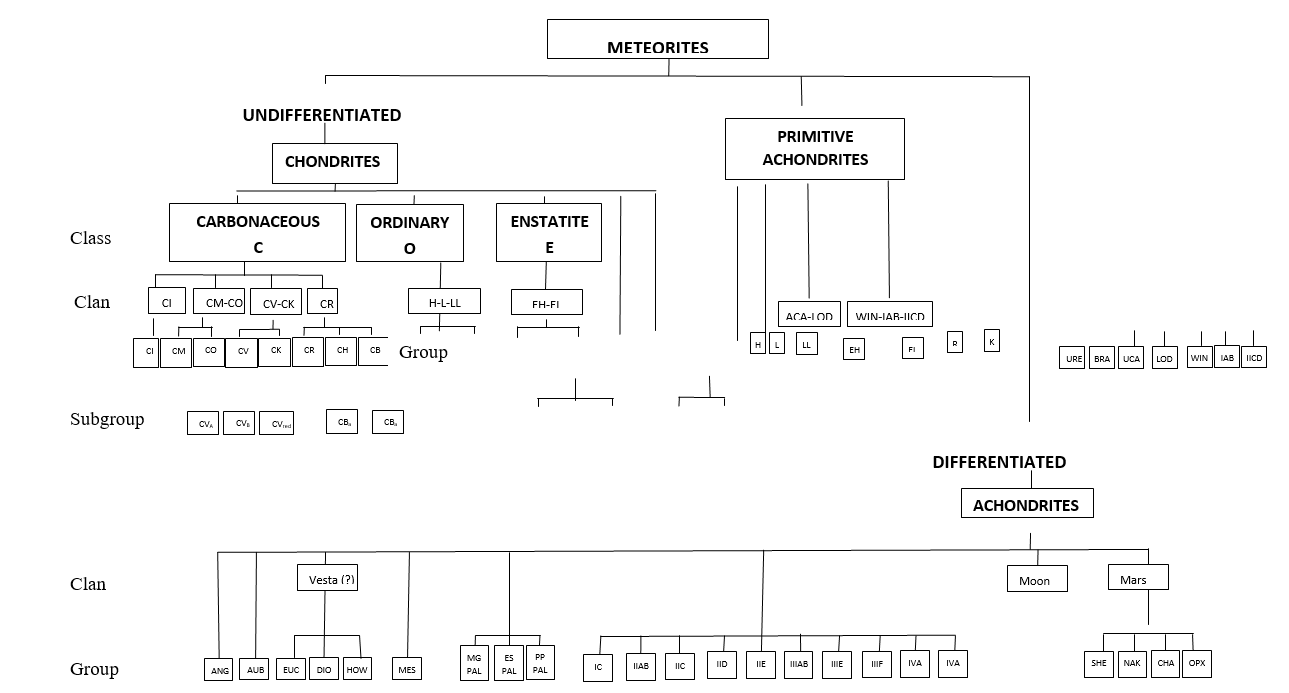
Fig. I: Diagram expressing the systematics of meteorite classification and showing the major meteorite divisions, classes, clans, and groups and relationships among meteorite groups (after Weisberg, M. K., McCoy, T. J., and Krot, A. N. 2006: Systematics and Evolution of Meteorite Classification: Meteorites and the Early Solar System II. D. S. Lauretta and H. Y. McSween Jr. (eds.), University of Arizona Press, Tucson, p.19-52).
Table-I: Average petrologic characteristics of the major chondrite groups (after Weisberg et al. 2006)
| Parameters | CI | CM | CO | CV | CK | CR | CH | CB | H | L | LL | EH | EL | R | K |
| Chondrule abundance (vol%)* | <<1 | 20† | 48 | 45 | 45 | 50-60 | 70 | 20-40 | 60-80 | 60-80 | 60-80 | 60-80 | 60-80 | >40 | 27 |
| Matrix abundance (vol%) | >99 | 70† | 34 | 40 | 40 | 30-50 | 5 | ≤1 | 10-15 | 10-15 | 10-15 | 2–15‡ | 2–15‡ | >36 | 73 |
| CAI-AOA abundance (vol%) | <<1 | 5 | 13 | 10 | 10 | 0.5 | 0.1 | ≤1 | ≤1 | ≤1 | ≤1 | ≤1 | ≤1 | 0 | ≤1 |
| Metal abundance (vol%) | 0 | 0.1 | 1-5 | 0-5 | 0-5 | 5-8 | 20 | 60-80 | 8 | 4 | 2 | 10 | 10 | 0.1 | 7 |
| Avg. chondrule diameter (mm) | NA | 0.3 | 0.15 | 1.0 | 1.0 | 0.7 | 0.02 | (0.2-1 cm) | 0.3 | 0.7 | 0.9 | 0.2 | 0.6 | 0.4 | 0.6 |
| Olivine composition (mol% Fa) | †† | †† | †† | †† | (<1–47)§29–33 | 1-3¶ | (<1–36)§2 ¶ | (2-3)§3¶ | (16-20)§19.3** | (23-26)§25.2** | (27-32)§31.3** | 0.4 | 0.4 | 38.0** | 2.2 |
* Chondrule abundance includes lithic and mineral fragments.
† Highly variable.
‡ The amount of matrix, if any, is not well established in E chondrites.
§ Range of compositions.
¶ Mode.
** Data for equilibrated varieties.
† Highly variable, unequilibrated.
NA=Not Applicable
† Highly variable.
‡ The amount of matrix, if any, is not well established in E chondrites.
§ Range of compositions.
¶ Mode.
** Data for equilibrated varieties.
† Highly variable, unequilibrated.
NA=Not Applicable
Table-II: Progressive stages of shock of ordinary chondrites. Only shock effects in olivine and plagioclase are used for classification (modified after Stӧffler et al. 1991 and references therein)
| Shock Stage | Effects resulting from equilibration peak shock pressure Olivine Plagioclase | Effects resulting from local P-T-excursions | Shock Pressure GPa | Post-shock temperature increase in ⁰C | ||
| Unshocked S1 | Sharp optical extinction, irregular fractures | none | <4-5 | 10-20 | ||
| Very weakly shocked S2 | Undulatory extinction, irregular fractures | none | 5-10 | 20-50 | ||
| Weakly shocked S3 |
| Opaque shock veins, incipient formation of melt pockets, sometimes interconnected | 15-20 | 100-150 | ||
| Moderately shocked S4 |
| Melt pockets, interconnecting melt veins, opaque shock veins | 30-35 | 250-350 | ||
| Strongly shocked S5 |
| Prervasive formation of melt pockets, veins and dikes; opaque shock veins | 45-55 | 600-850 | ||
| Very strongly shocked S6 | Restricted to local regions in or near melt zones
| as in stage S5 | 75-90 | 1500-1750 | ||
| Shock melted | Whole rock melting (impact melt rocks and melt breccias) |
References
Bhattacharya, A and Dutta, A. (2016): Raman spectroscopic studies of shock induced diamonds from ordinary chondritic meteorites. 47th Lunar and Planetary Science Conference (LPSC), Abstract # 2150.
Chattopadhyay, B.K and Sengupta, S.K.(2010): Petrographic and mineral phase chemistry studies on different types of high and low temperature components in H, L, LL group chondrites and their genetic significance. Unpublished Report, Geological Survey of India, FS 2007-2009
Chattopadhyay, B.K. (2004): Lecture notes on Meteorites (Unpublished).
Chen, M., Goresy, A. El., and Gillet, P (2004):Ringwoodite lamellae in olivine: Clues to olivine–ringwoodite phase transition mechanisms in shocked meteorites and subducting slabs.PNAS 101, 15033-15037.
Chen M., Sharp T. G., El Goresy A., Wopenka B., and Xie X. (1996): The majorite-pyrope + magnesiowüstite assemblage: Constraints on the history of shock veins in chondrites. Science 271, p. 1570 –1573.
Dodd, R.T. (1981):Meteorites – A petrologic – chemical synthesis. Cambridge University Press, U.S.A.
Dodd Jr. R.T., Van Schmus, W.R., and Koffman, D.M. (1967): A survey of the unequilibrated ordinary chondrites. Geochimica et Cosmochimica Acta 31, p. 921-951.
Ghimire, B., Dall’Asén,A., Gerton,J., Ivans,I., and Bromley, B. (2012):Raman spectroscopy investigation in the NWA 3118 meteorite: Implications for planet formation. Natural Sciences. P. 6-8.
Ghosh, S and Dube, A. (1999): Pictorial Catalogue on One Hundred Indian Meteorites. Geological Survey of India, Catalogue Series No. 3.
Hutchison, R. (2006): Meteorites – A Petrologic, Chemical and Isotopic synthesis. Cambridge University Press, U.K.
Kretz, R., (1983). Symbols for rock-forming minerals. Amer. Min.,68, p. 277-279.
Langenhorst F., Joreau P., and Doukhan J. C. (1995): Thermal and shock metamorphism of the Tenham chondrite: A TEM examination. Geochimica et Cosmochimica Acta 59, p. 1835–1845.
Nagy,Sz., Fintor,K., Pál-Molnár,E., Gyollai,I., and Veres, M. (2013):Evidence for significant cation disordering in ringwoodite from NWA 5011 and Tenham shocked chondrite: A possible disordered unrelaxed ringwoodite structure.44th Lunar and Planetary Science Conference (LPSC), Abstract # 1177.
Price G. D., Putnis A., and Agrell S. O. (1979): Electron petrography of shock-produced veins in the Tenham chondrite. Contributions to Mineralogy and Petrology 71, p. 211–218.
Ringwood, A.E. (1961): Chemical and genetic relationships among meteorites. Geochimica et Cosmochimica Acta. 24, p. 159–197.
Rubin, A.E. (1997): Mineralogy of meteorite groups. Meteoritics and Planetary Science 32, p. 231–247.
Sen Gupta, P.R and Sen Gupta, S. (1982): Catalogue of the meteorite collection of the Geological Survey of India in the Indian Museum, Calcutta.Geological Survey of India, Catalogue Series No. 1.
Sharp T. G., Lingemann C. M., Dupas C., and Stöffler D. (1997): Natural occurrence of MgSiO3 ilmenite and evidence for MgSiO3 perovskite in a shocked L chondrite. Science 277, p. 352–355.
Smith J. V. and Mason B. (1970): Pyroxene-garnet transformation in Coorara meteorite. Science 168, p. 832–833..
Stӧffler, D., Keil, K., and Scott, E. R. D. (1991). Shock metamorphism of ordinary Chondrites. Geochimica et Cosmochimica Acta 55, p. 3845 – 3867.
Treiman, A., and Treado, P. (1998): Martian maskelynite? Raman spectra of plagioclase-composition glass from ALH84001, EETA 79001, and ALHA 77005. XXIX Lunar and Planetary Science Conference (LPSC), Abstract #1196.
Tomioka N. and Fujino K. (1997): Natural (Mg,Fe)SiO3 ilmenite and perovskite in the Tenham meteorite. Science 277, p. 1084–1086.
Van Schmus, W.R., and Wood, J.A. (1967): A chemical-petrologic classification for the chondritic meteorites. Geochimica et Cosmochimica Acta 31, p. 747-765.
Weisberg, M. K., McCoy, T. J., and Krot, A. N. (2006): Systematics and Evolution of Meteorite Classification: Meteorites and the Early Solar System II. D. S. Lauretta and H. Y. McSween Jr. (eds.), University of Arizona Press, Tucson, p.19-52.
Wood, J. A. (1958): Silicate meteorite structures and the origin of the meteorites. Smithsonian Institute Astrophysics Obs. Report No. 10.
Xie, Z. and Sharp, T.G. (2007): Host rock solid-state transformation in a shock-induced melt vein of Tenham L6 chondrite. Earth and Planetary Science Letters 254, p. 433–445.